
Why We Raise Our Voices: What Is Hiding Underneath the Anger
You heard your own voice get louder.
You saw the face across the table go quiet.
And somewhere in your chest you thought: not again.
We raise our voices when something feels threatening: losing control, being overlooked, or failing. Underneath the anger there is often a sudden rise of fear. Lashing out is the body's attempt to feel safe again. It can bring short-term control, then cost trust, which raises fear and restarts the loop.
Recognising yourself? Starting takes one email. You do not have to be ready.
Reach out to beginWhat is really happening when you raise your voice?
I get it.
I absolutely get it. Nobody wakes up wanting to be the person who snaps.
Anger rarely arrives alone. It often arrives as cover for something more exposed underneath: fear. Fear of losing control. Fear of being overlooked. Fear of failing where it matters.
The body does not stop to ask which fear it is. It reads threat, and it moves. Louder. Faster. Tighter.
That is the one idea in this post: anger is often fear that found its voice first. This is not an excuse. It is a map. And you cannot change a map you refuse to read.
The 8-step loop underneath anger and anxiety
Here is the loop, step by step. Read it slowly. Find the step where you usually live.
The threat
A fear of losing control or power, being overlooked, or failing.
Anxiety
Under the anger there is often a sudden rise in fear.
Lashing out
Snapping, micromanaging, sudden defensiveness, or tightening control over everything.
The consequence
Because of the reaction, other people back down and retreat.
The mindset
The brain can mistakenly learn that lashing out brings control.
The cost
Trust breaks with the people you love most, and you cut yourself off from the very people you are working to protect.
Increased anxiety
The alienation and broken connection trigger even more fear.
The loop continues
That fear is read as a new threat, and the cycle repeats.
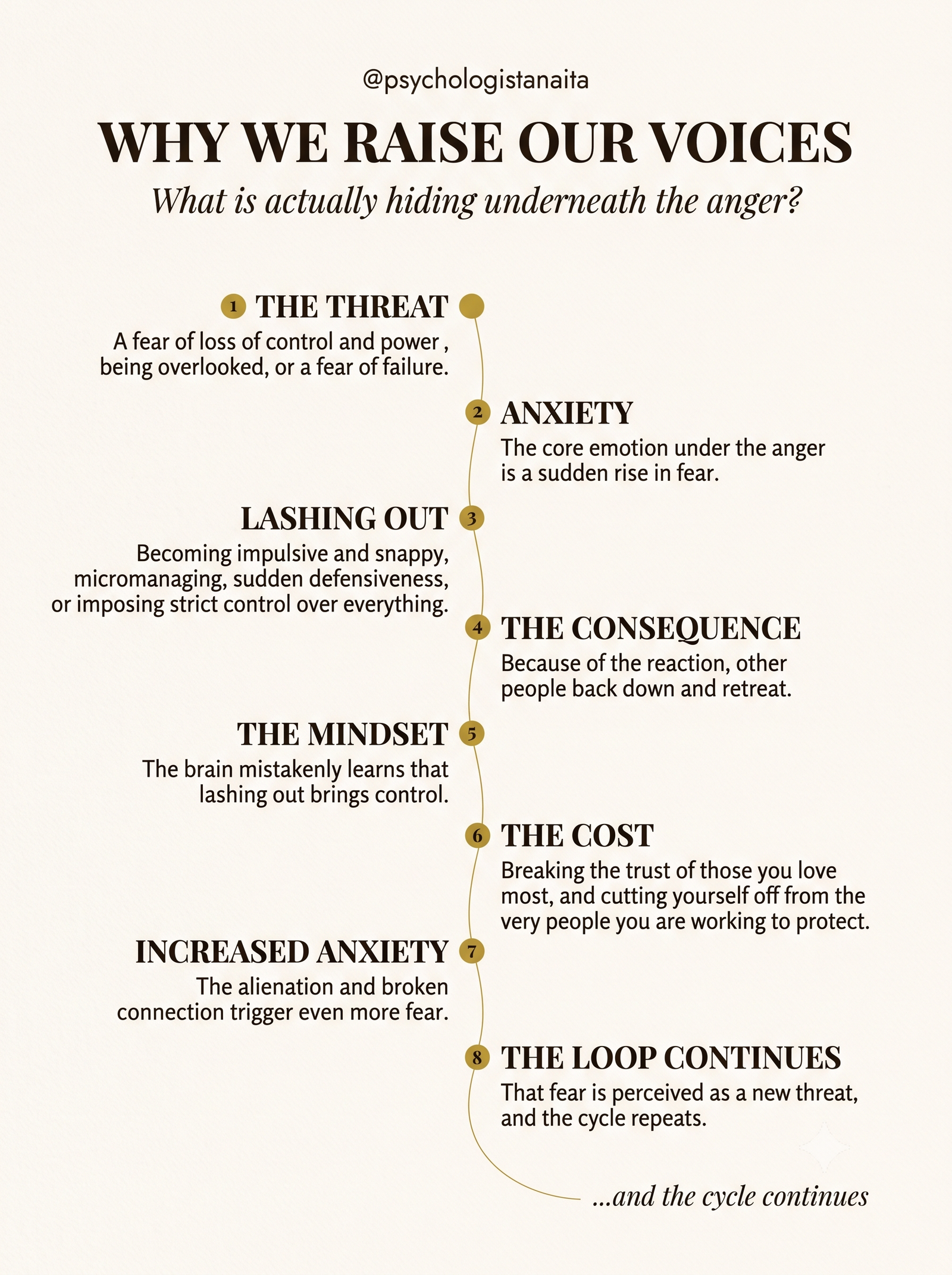
Look closely at step 5. The brain can mistakenly learn that lashing out brings control. It worked for a moment. People backed down. The body filed it under "effective". That is why the pattern repeats even in people who deeply value kindness.
It is also why this is not about willpower. A loop that has been rewarded will keep running until it is seen.
What staying in the loop costs
Be honest about the bill.
Trust. The people you love begin to measure their words around you.
Closeness. Their distance feels like safety to them and like abandonment to you, which feeds the fear.
Energy. Living on high alert can wear on sleep, patience and health.
And the hardest cost of all: you end up cut off from the very people you are working to protect.
What can shift when you see the loop
You do not need to become a calm person overnight. Nobody does.
What often shifts first is the gap. A small pause between the threat and the reaction. In that gap you can ask one question: what am I afraid of right now?
Over time many people find they can name the fear, say the truth about it, and repair faster when they miss. There is no timeline and no guarantee. There is a direction.
Here is where I draw a line.
Counting to ten, breathing exercises, quick scripts: all useful. But tools poured into a full glass overflow. Empty the glass first. Then fill it on purpose.
If the glass is full of fear you have never looked at, the tool spills on the first hard day. Looking comes before fixing.
One thing to do now: the 10-minute Loop Map
Free. Pen and paper. No fixing yet. Only seeing.
- Pick the last time your voice went up. Not the worst one. The most recent.
- Write the threat. What did I fear losing in that moment: control, respect, being seen, getting it right?
- Write the body. Where did it start: jaw, chest, hands, stomach?
- Write what you did, and what the other person did next.
- Write what you told yourself afterwards: "I had to", "they pushed me", "I am just like that".
- Write one repair sentence you could say today: "I raised my voice. Underneath it I was afraid of ____. I am sorry for how it landed."
Ten minutes. That is the whole practice.
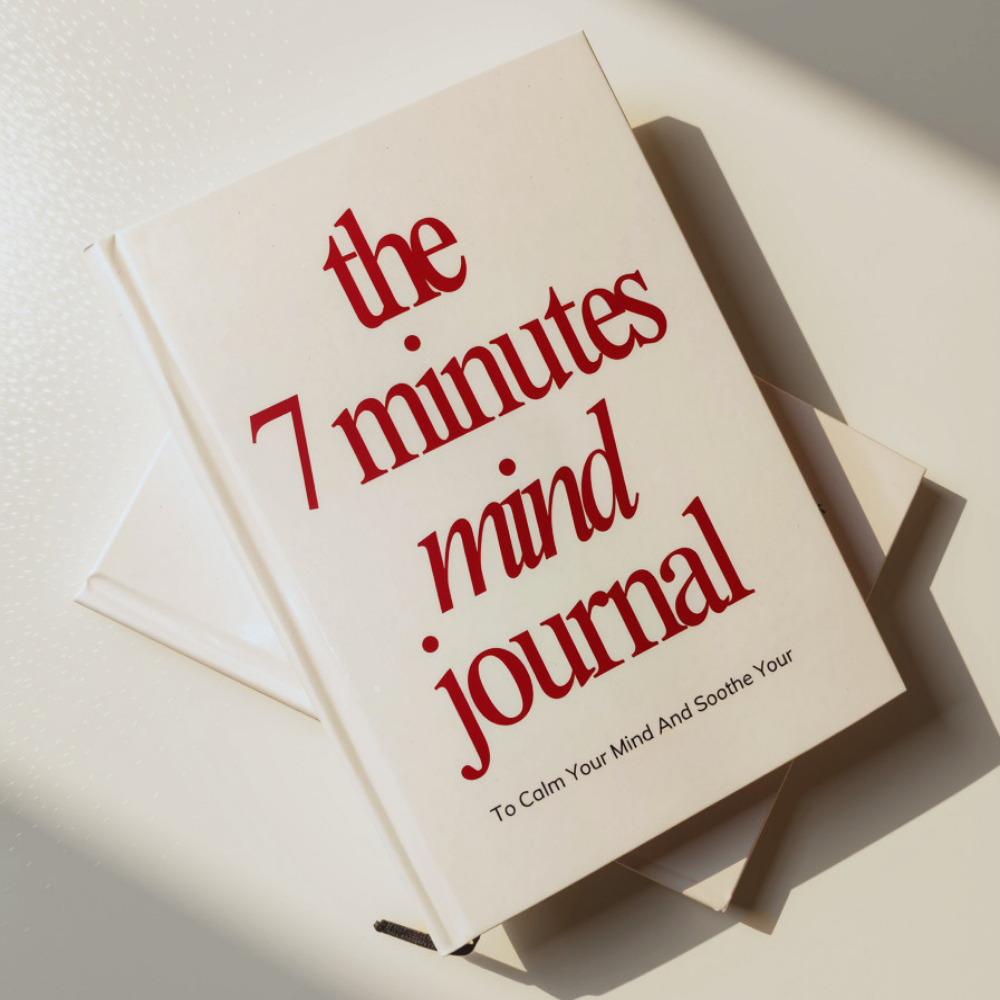
Between sessions, or before your first
The 7-Minute Mind Journal
A blank page loops. Structure settles. This is India's first mind-body integrated self-care journal: 7 minutes a day over a 62-day cycle, one prompt at a time, built by me as a Licensed Psychologist. A 243-page hardcover for beginners and advanced journalers alike.
It supports therapy. It never replaces it.
Get the journal nowWhen a free practice is not enough
Some loops loosen with a page and a pen. Some are older than that. They were often built early, in rooms where a raised voice meant something, and they need company to untangle.
That is what the weekly work is for. In the first session, an exploratory session of 50 minutes, we map what you carry and how it shows up. The weekly package then builds on that, week by week. If anxiety sits under your anger, my anxiety therapy page explains how I work with it, and the therapy page walks through the full process. If overthinking replays the moment for hours afterwards, read how to stop overthinking next.
What happens next is simple. You reach out. I send the consent and baseline forms. We commit. We begin.
Starting takes one email. You do not have to be ready.
Reach out to beginFrequently asked questions
Why do I raise my voice when I am angry?
Raising your voice is usually a protective reaction. When the mind reads a threat to your control, status or sense of getting it right, the body moves toward speed and volume. It can feel like power in the moment, which is why the pattern often repeats even in people who value calm.
Is anger really just fear underneath?
Not always, but often. Anger is frequently a secondary emotion that rises to cover something more exposed, such as fear, hurt or shame. Asking what you are afraid of losing in that moment is a useful first step. It does not excuse the behaviour. It explains where it starts.
Why do I snap at the people I love the most?
Closeness raises the stakes. The people you love matter most, so fear of losing control, being overlooked or failing them can feel sharper at home. Safe people also tend to absorb the reaction. That is exactly why the cost lands there, and why repair matters so much.
How do I stop yelling when I feel out of control?
Start by widening the gap between threat and reaction. Slow your exhale, unclench your jaw and hands, and name the fear in one sentence before you speak. Tools like these work better when you have also looked at what the anger protects. Many people find support makes that easier.
When should I see a psychologist about my anger?
Consider support if the same blow-ups repeat, trust at home or work is thinning, or you feel ashamed afterwards but cannot change the pattern alone. Therapy is not crisis care. If anger has turned physical or you fear hurting someone, contact a helpline or someone you trust today.
If your anger has turned physical, or you are afraid you may hurt yourself or someone else, please do not wait for a session. Vandrevala Foundation: +91 9999 666 555 (24/7). iCall: 9152987821 (Mon to Sat). Outside India: findahelpline.com. If you are on the receiving end of someone's anger and do not feel safe, reach out from a device the other person cannot see. Therapy is not crisis care.